
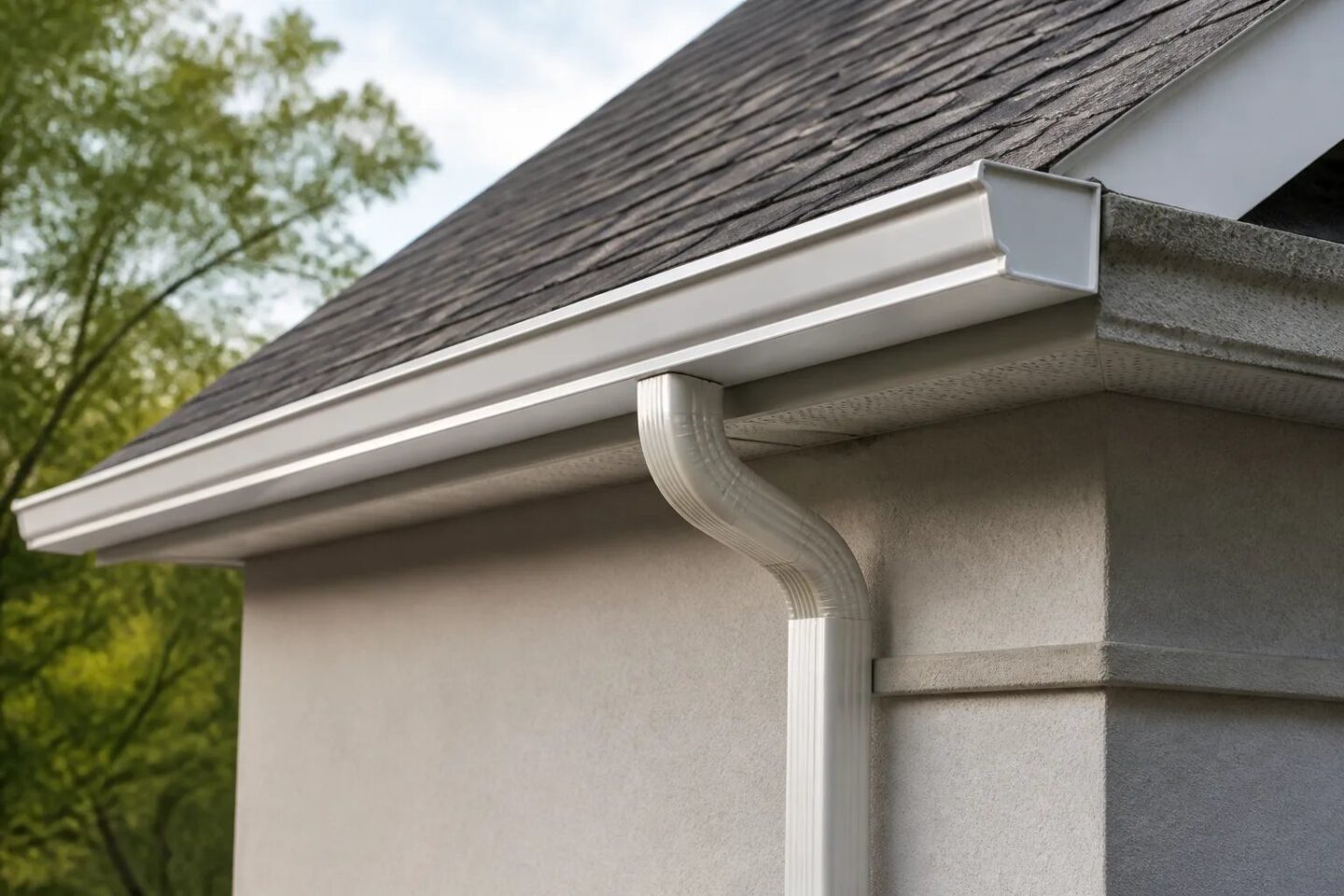
Seamless aluminum eavestrough installation in Oakville reduces the number of joints along the straight sections of a roofline. That can remove several potential leak points, but it is not a complete answer to every overflow, sagging, or drainage problem. Corners, end caps, outlets, downspouts, secure attachment, and the final discharge point still need to work together.
At Oakville Eavestroughs & Gutters, we plan seamless aluminum systems as a connected water path: roof edge, trough, outlet, downspout, and discharge at grade. That approach helps separate a straightforward run replacement from a larger issue involving roof runoff concentration, fascia condition, or drainage routing.
What “seamless” means on an installed eavestrough
A seamless eavestrough is formed into a long continuous length for a measured straight run. Unlike a system assembled from shorter lengths, it does not require field joints at regular intervals along that run. Fewer straight-run joints means fewer locations where a joint can separate or where sealant can eventually fail.
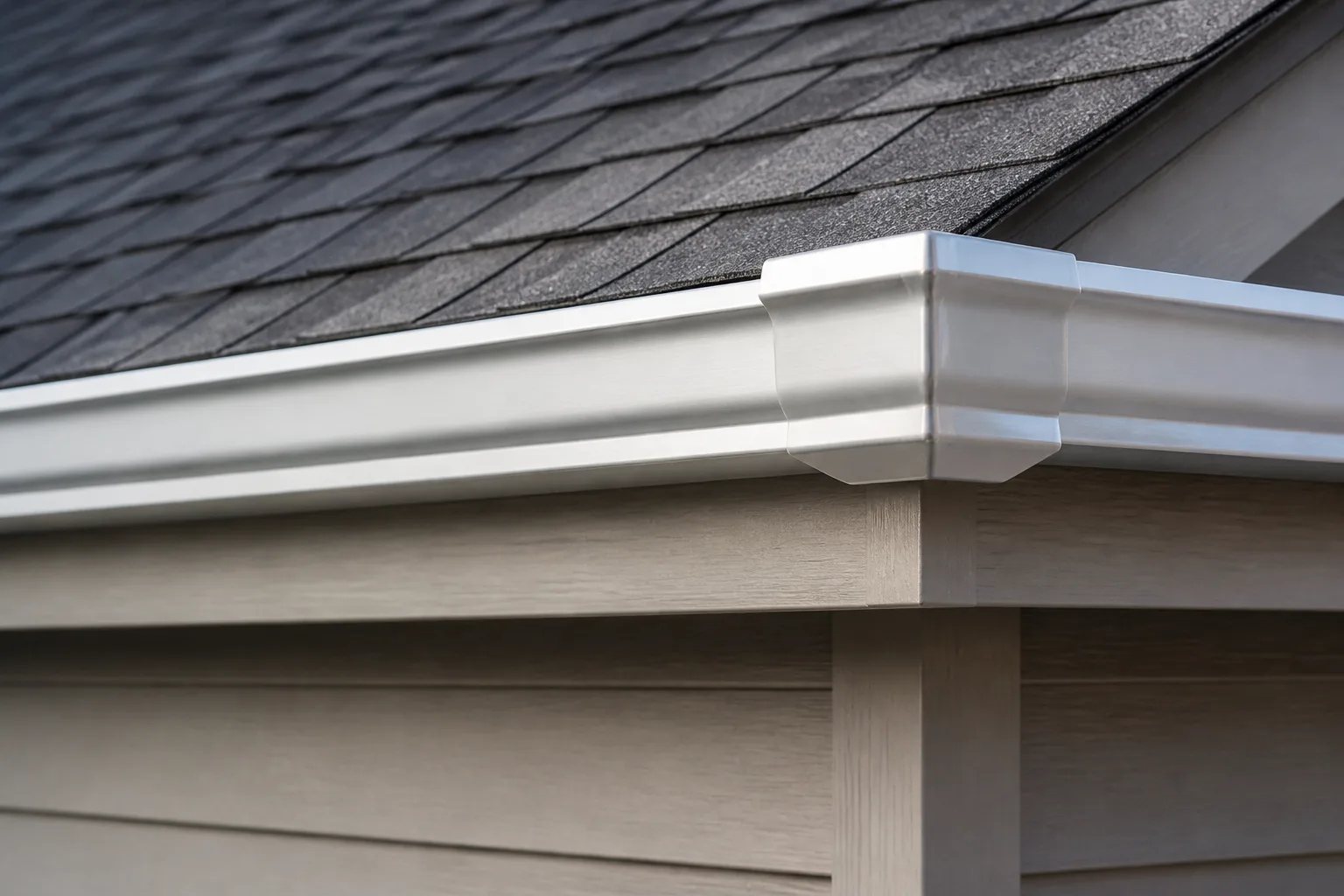
Seamless does not mean one unbroken piece around an entire home. Every roofline still needs connections at corners, end caps, and outlet openings. Those details must be prepared and secured correctly, and the run must be set with suitable alignment and slope toward its outlet.
The material choice alone also cannot correct water that is collecting because of a low section, backing up at a restricted outlet, or discharging in the wrong place. For a closer look at the material and system scope, see our seamless aluminum eavestrough service.
Why the whole roofline matters more than the number of joints
The trough is only the collection point. A run that looks clean and continuous can still struggle if water enters faster than its outlet and downspout can carry it away. Valleys, dormers, and roof transitions can send concentrated water into a short section, even where the total roofline seems ordinary.
Before defining a system, the useful questions are:
- Which roof planes drain into each run?
- Are valleys or roof transitions concentrating flow in one area?
- Where can outlets be placed without creating an awkward downspout route?
- Is the visible fascia and supporting material in condition for secure attachment?
- Where will water leave the downspout once it reaches grade?
This is why a new trough should not be viewed as an isolated upgrade. A larger or seamless run cannot overcome a restricted elbow lower down, and a new downspout does not solve a discharge route that sends water toward the foundation, a walking path, or a property boundary.
Five-inch or six-inch? Choose capacity from roof runoff
We offer seamless aluminum eavestroughs in five-inch and six-inch systems. Neither profile is automatically the better choice. Five-inch systems serve many homes, while six-inch profiles can be appropriate where roof area, pitch, valleys, or concentrated runoff create a documented need for more capacity.
The critical point is that the trough profile, outlet size, and downspout route must be planned together. Increasing the trough size without considering the outlet and downspout can simply move the restriction downstream. Fascia space and the visual proportion of the roofline also belong in the decision.
Our six-inch and high-capacity eavestrough page explains the conditions that can justify a larger profile. A review of the roof geometry and water path is more useful than choosing a size based on the age or apparent size of the home alone.
Attachment and fascia should be reviewed before new aluminum goes up
An eavestrough depends on the condition of the material that supports it. Visible movement, a gap at the fascia interface, sagging, or a bowed front edge can point to issues with fasteners, retained debris and water, deformed aluminum, or the support behind the trough. New aluminum should not conceal failed supporting material.
From ground level, you can note an uneven roofline edge, standing water after a storm, staining, or a section pulling away. Those observations are useful, but they do not confirm the condition behind the existing trough. Where accessible, the attachment points and fascia interface should be part of the review before the final scope is set.
If related roofline work is needed, we keep it distinct rather than burying it in a general allowance. Our fascia installation and replacement service and exterior aluminum capping service address different roofline components and should not be treated as interchangeable.
Plan downspouts and final discharge at the same time
A properly formed seamless run still needs a clear exit for collected water. Outlets, elbows, vertical downspouts, extensions, and surface drainage all affect whether runoff moves away from the building without creating a new problem elsewhere.
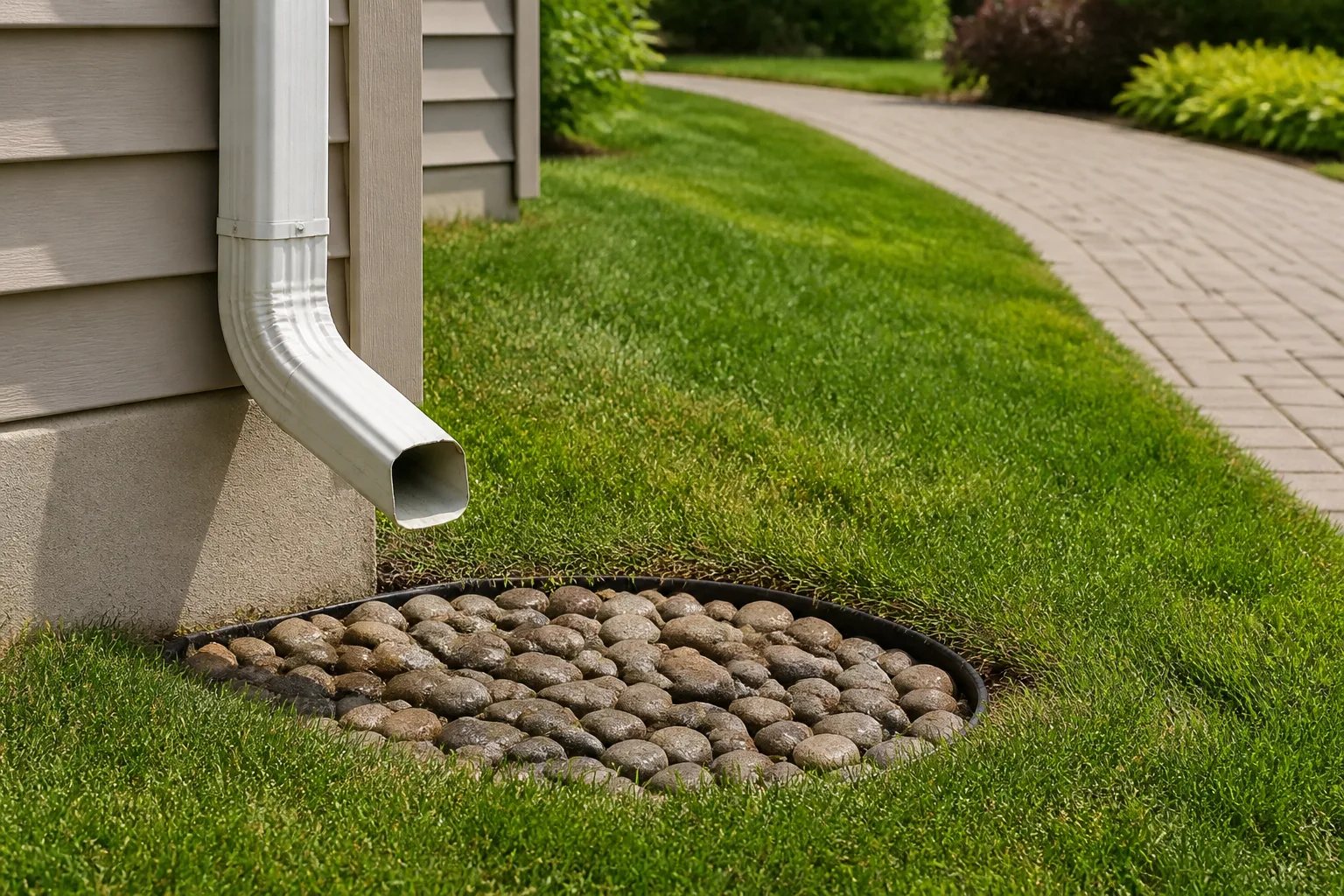
Oakville guidance says property owners are responsible for maintaining grading and surface drainage. It advises directing downspouts onto splash pads or hard surfaces that move water away from the house, while avoiding extensions to a property line or onto neighbouring property. Existing swales and sheet-drainage paths also need to remain functional.
There is no universal extension length that fits every lot. Grade, landscaping, hard surfaces, walkways, driveways, boundaries, and winter icing exposure all change what a sensible route looks like. An above-ground extension is also different from excavation, grade changes, or a connection to an underground line, which can introduce separate property and approval questions.
Drainage boundary
Keep roof runoff on a route that works at grade
In Oakville, a downspout route should move water away from the house without crossing a walking route, blocking a swale, or directing concentrated flow to a property line or neighbouring land. A new eavestrough is only one part of that drainage decision.
What to document before requesting an estimate
Photos and a concise description can help us understand the visible roofline and prepare for a site review. They cannot reliably show concealed support, exact slope, or conditions inside a blocked outlet, so final recommendations depend on what can be reviewed at the property.
Estimate preparation
Information that helps define the seamless eavestrough scope
A few clear observations help identify the affected area and the questions that need an on-site review.
- Property type and number of storeys
- The affected elevation or roofline section
- What happens during rain, including overflow, drips, standing water, or poor discharge
- Visible valleys, dormers, or roof transitions above the affected run
- Whether the issue is isolated or appears at several locations
- Safe ground-level photos of the roofline, downspout, and discharge area
- Known gates, vehicles, landscaping, or other access considerations
How to compare seamless eavestrough proposals
A meaningful proposal identifies the actual elevations and components being addressed, rather than simply listing “seamless gutters.” Measured runs, profile, colour, corners, end caps, outlets, downspouts, removal, and disposal should be clear. If gutter guards, soffit, fascia, capping, or drainage extensions are being considered, each item should remain visible as its own part of the scope.
It is also useful to understand what could remain unknown until existing material is removed. Conditions behind old aluminum or inside a closed outlet are not always visible in advance. A clear scope should distinguish what was observed from what may require attention after closer access.
When comparing options, make sure the assumptions match. Confirm whether both proposals include the same profile, downspouts, access needs, disposal, colour, and lower drainage work. A lower figure is not necessarily a narrower scope, and a broader package is not necessarily justified unless it explains why every component is needed.
Maintenance still matters after installation
Seamless aluminum reduces straight-run joints, but it does not remove the need to inspect visible alignment, outlets, and discharge points. Leaf fall, seeds and needles, roof valleys, freeze-thaw cycles, and intense storms can all affect how often a system needs attention.
Gutter guards can reduce the entry of larger debris, but they do not eliminate maintenance or make outlet inspections unnecessary. Maintenance timing should reflect the actual tree cover, debris pattern, roof geometry, and past restrictions at the property. Our gutter cleaning and maintenance service is available for properties that need a focused cleaning and inspection scope.
When seamless replacement may not be the narrowest solution
Replacement is not automatic when a system leaks. A single corner, end cap, outlet, hanger, or short damaged section can sometimes be repaired when the surrounding material, attachment, and layout remain serviceable. Broader replacement becomes more reasonable when failure is repeated or widespread, the existing runs are extensively deformed, attachment is unreliable, or the outlet and downspout layout needs redesign.
The most useful decision starts with the failure pattern and follows the water path rather than assuming every visible drip points to the same repair. For a direct comparison of those options, visit our eavestrough repair versus replacement guide.
A seamless aluminum system is most effective when its continuous runs are paired with sound support, appropriate capacity, clear outlets and downspouts, and a discharge route that respects the property’s existing drainage pattern.
Helpful answers
Frequently Asked Questions
Plan your seamless eavestrough scope
Tell us about the affected roofline, number of storeys, visible drainage concern, and any safe ground-level photos so we can review the complete water path.