
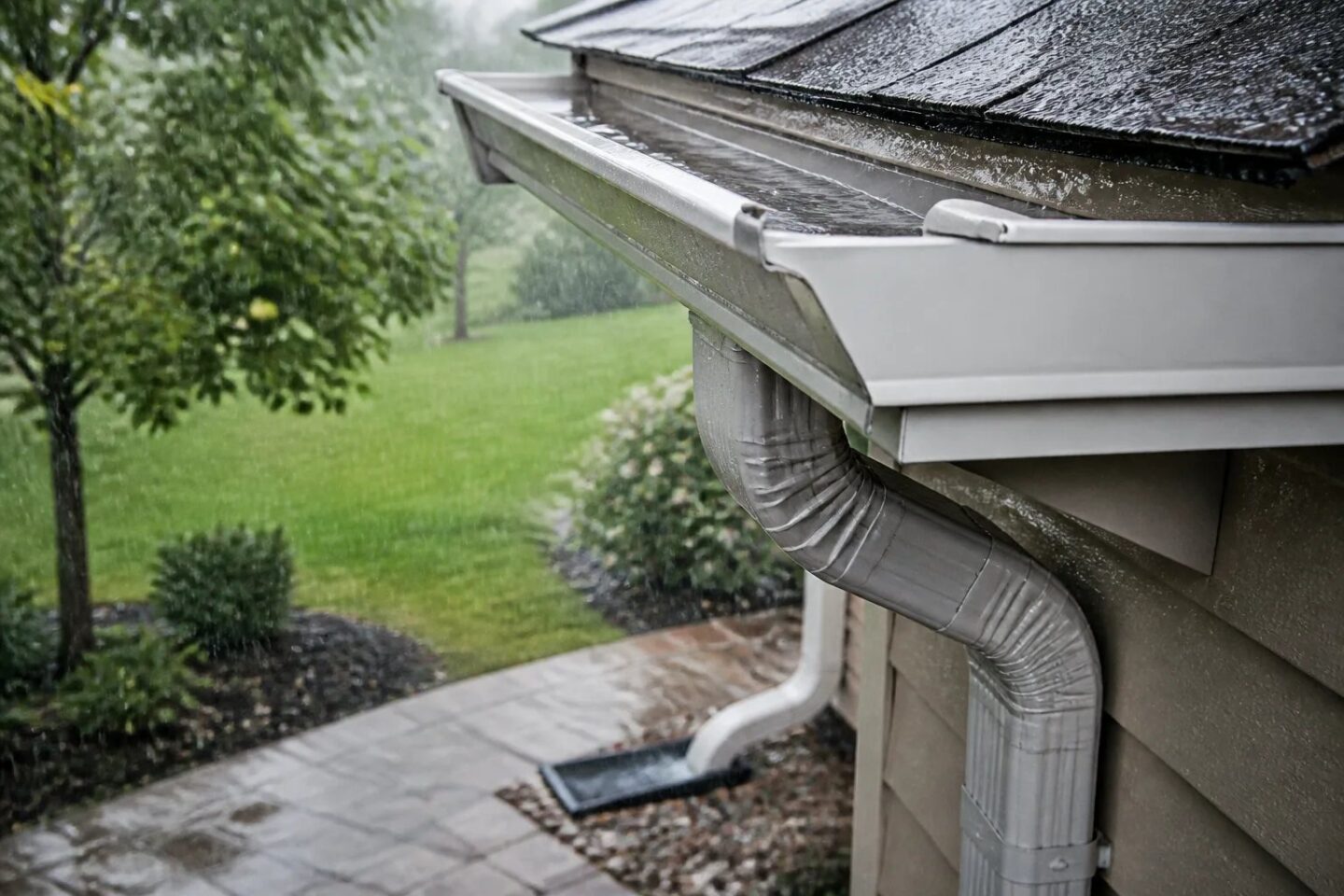
A leaking eavestrough often has a repairable local cause, such as a failed corner, separated joint, loose hanger, damaged outlet, or short damaged section. But a reliable leaking eavestrough repair in Oakville starts by following the whole water path: where water enters the trough, how it reaches the outlet, how it moves through the downspout, and where it lands at grade. Repairing the visible drip alone can leave the condition that caused it in place.
At Oakville Eavestroughs & Gutters, we provide targeted repair for localized eavestrough failures. The appropriate scope depends on the condition of the surrounding run, its attachment, the outlet and downspout route, and the final discharge location.
Start by locating the leak and noting when it happens
The timing and position of a leak offer useful clues. Observe from the ground when it is safe to do so, and note the affected elevation rather than describing the entire building as having a gutter issue.
- Water dripping from a corner: A mitre can leak when sealant has failed, the joint has moved, the metal has deformed, or water is sitting in that area instead of draining away.
- Water running behind the eavestrough: This can point to an attachment, alignment, fascia, or roof-edge issue. The condition of the material supporting the trough matters as much as the visible aluminum.
- Overflow over the front edge: Debris is one possibility, but so are a restricted outlet, a blocked downspout, poor slope, a low section, concentrated valley flow, or insufficient capacity for that part of the roof.
- Water escaping near a downspout: The outlet, upper elbows, vertical downspout, and lower routing should all be considered. A restricted transition can cause water to back up into an otherwise sound trough.
- A sagging or detached section: Loose hangers, fasteners, or unsuitable support behind the trough can prevent a simple reseal from being a durable answer.
Photos showing the affected run, nearby roof valleys, visible staining, and the lower downspout route can help describe the issue. They cannot confirm concealed support, internal blockages, or exact slope, so a property-specific review may still be needed.
When is a localized eavestrough repair appropriate?
A local repair is often reasonable when the failure is isolated and the adjacent material, attachment, and layout remain serviceable. For example, one leaking corner on a straight, securely attached run calls for a different response than leaking joints and sagging sections across several elevations.
Our eavestrough repair service addresses localized concerns including leaking corners, loose hangers, separated joints, damaged outlets, and short damaged sections. The key question is not simply whether a component can be patched. It is whether the retained system can support the repair and move water as intended.
| Observed pattern | Why it matters |
|---|---|
| One defined leak or damaged component | The surrounding run may be suitable for a targeted repair if it remains sound and secure. |
| Several leaks on different runs | Widespread failures can indicate that repeated small repairs will not address the broader condition. |
| Persistent sagging or troughs pulling away | Attachment and fascia support need review before retaining the existing run. |
| Overflow below a valley or during intense rain | The issue may involve roof concentration, outlet placement, downspout restriction, slope, or capacity rather than a leaking seam. |
| Repeated repairs in different locations | A broader replacement or section replacement may provide a clearer long-term scope. |
For a fuller condition-based comparison, see our guide to eavestrough repair versus replacement. Replacement is not automatically necessary because one component has failed, and repair is not automatically economical when problems are widespread.
Why a leak should be traced through the complete water path
An eavestrough is a connected drainage system, not just a horizontal channel at the roof edge. Roof area, pitch, and valleys determine how much water reaches a run. Trough alignment and outlets guide the flow. Downspouts carry it downward. Extensions, splash pads, hard surfaces, grade, and swales influence where concentrated runoff goes next.
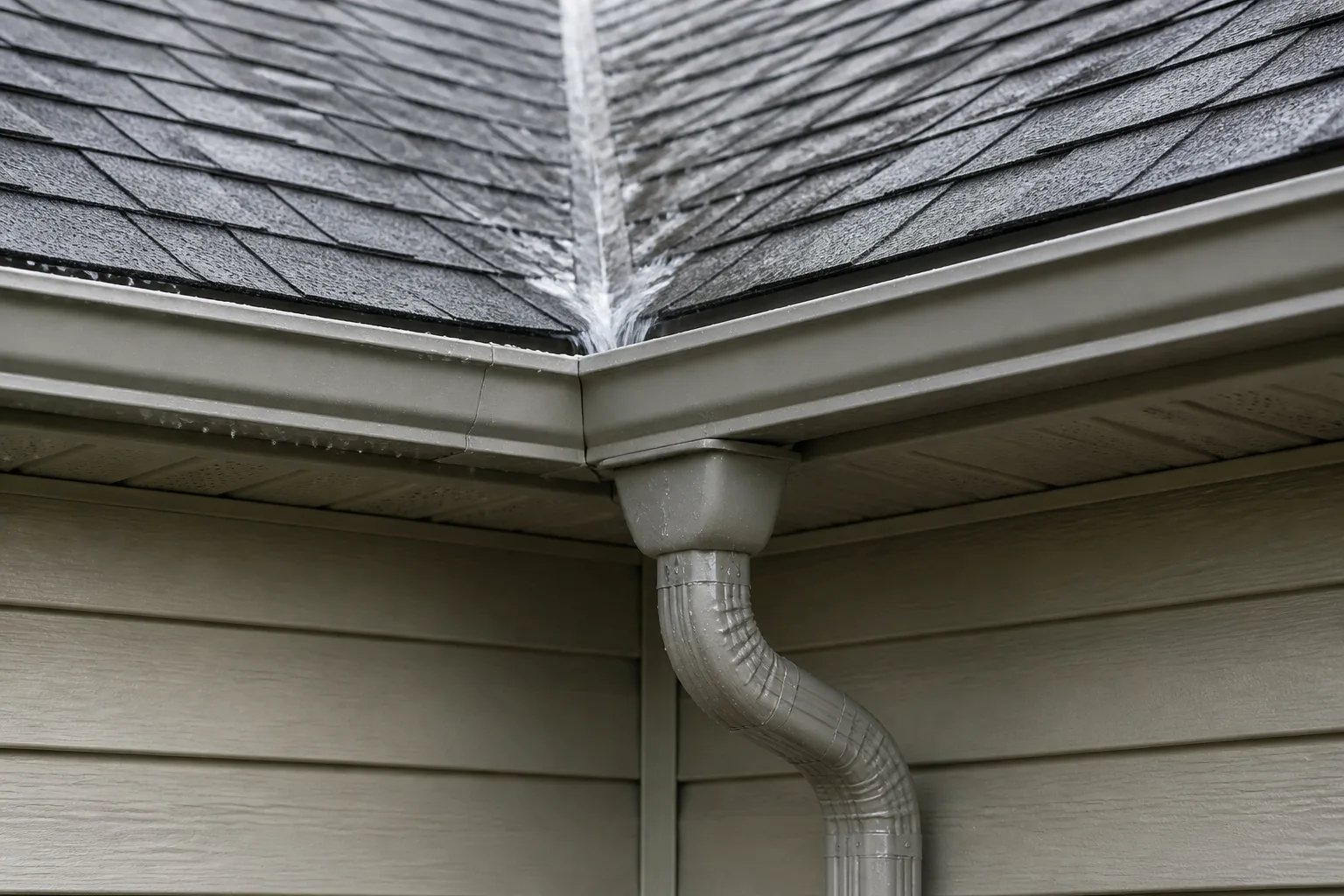
This is why a larger trough by itself does not solve every overflow problem. If the outlet is undersized or restricted, or if the downspout route cannot handle the flow, water can still back up. Likewise, replacing a downspout will not correct a blocked or poorly sloped trough above it.
Properties with large roof planes, steep sections, or valley concentration sometimes need a capacity review. Five-inch systems can serve many residential roof areas, while six-inch profiles may suit larger or more concentrated roof flows when outlets, downspouts, and fascia space support the change. The profile should answer a documented need, not be selected as an automatic upgrade. Our 5-inch versus 6-inch eavestrough guide explains the considerations in more detail.
Keep the downspout discharge point in the repair scope
A repair should not improve collection at the roof edge only to direct more water toward the building, a walkway, or a property boundary. Oakville guidance states that property owners are responsible for maintaining grading and surface drainage. It advises discharging downspouts onto splash pads or hard surfaces that direct water away from the house, without extending them to a property line or onto neighbouring property.
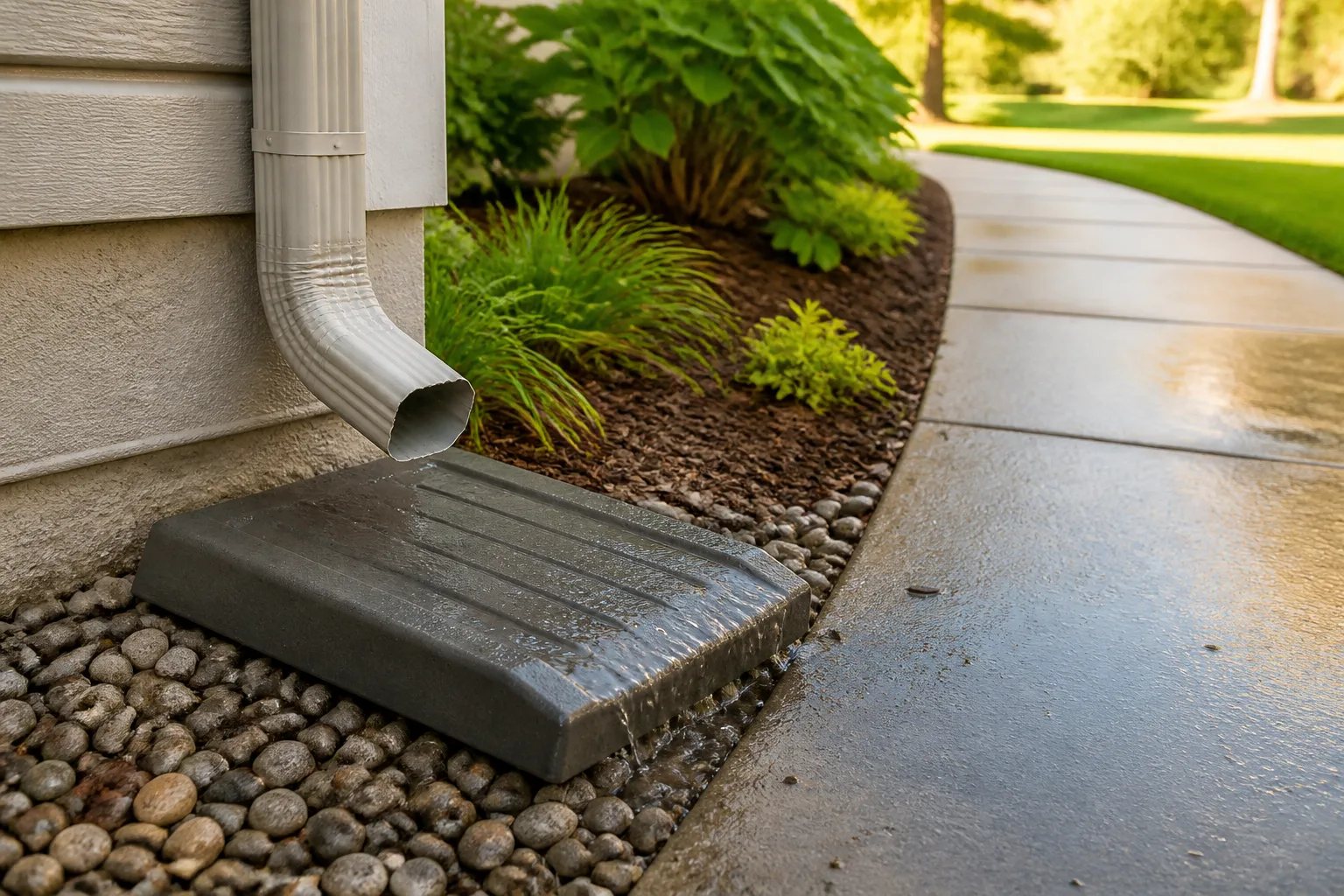
The correct route is specific to the lot. Grade, landscaping, hard surfaces, existing swales, driveways, and pedestrian routes all affect what is workable. There is no universal extension length that fits every property. Work involving excavation, grading changes, municipal right-of-way areas, or other site changes should be identified separately rather than assumed to be part of ordinary eavestrough repair.
Oakville drainage context
A repaired downspout still needs a suitable discharge route
Oakville guidance advises directing downspout flow away from the house on a splash pad or hard surface, while keeping swales functional and avoiding discharge at property lines or onto neighbouring land. The appropriate route depends on the grade and features of the individual property.
If water crosses a walkway or driveway, it deserves special attention before winter conditions create an icing concern. The visible condition at the roofline is only one part of the drainage decision. For more detail, read our Oakville downspout and property drainage guide.
What a clear repair estimate should identify
Comparing repair proposals is easier when each one describes the same scope. A general phrase such as “gutter repair” does not explain which run, component, or water-path issue is being addressed.
A useful written scope should make the following clear:
Proposal checklist
Details to look for in a repair scope
Before comparing estimates, confirm that each scope identifies the same roofline conditions and connected components.
- Affected elevation, measured run, and specific components to be repaired
- Corners, end caps, joints, hangers, outlets, downspouts, and retained sections included in the scope
- Access, building height, protection needs, removal, and disposal assumptions
- Any related fascia, soffit, aluminum capping, guard, or drainage work listed separately
- Known exclusions, concealed-condition limits, and conditions that could change the scope
- The intended lower discharge route and any surface-drainage work outside the eavestrough scope
Some conditions cannot be fully confirmed until closer access or removal exposes them. For example, the support behind a loose section or the condition inside a closed outlet may not be visible from ground level. A clear scope separates observed conditions from unknown conditions rather than treating concealed material as already confirmed.
Prepare useful information before requesting a repair review
There is no need to diagnose the system yourself. A few organized observations can make the starting point clearer and help distinguish a roof-edge leak from a drainage concern farther along the route.
- Identify the front, rear, or side elevation where the problem occurs.
- Note the number of storeys and any access limitations around that area.
- Describe whether the issue occurs in light rain, prolonged rain, intense storms, snowmelt, or freezing conditions.
- Record obvious symptoms such as dripping corners, sagging, standing water, overflow, staining, separated joints, or a weak downspout discharge.
- Take safe ground-level photos of the affected roofline and where the nearest downspout discharges.
- Mention nearby valleys, walkways, driveways, landscaping, swales, and recent roof, paving, or landscaping changes.
After a repair, continue to check visible alignment, outlets, and discharge points over time, especially after leaf fall, freeze-thaw cycles, and intense storms. Maintenance timing should reflect the roofline, tree cover, debris type, and what the system collects rather than a one-size-fits-all calendar. Our gutter cleaning and maintenance service is available for properties that need debris and drainage conditions addressed as part of ongoing care.
The narrowest complete repair is usually the most useful one: it addresses the documented failure while accounting for the components that move water before and after it.
Helpful answers
Frequently Asked Questions
Get a clear scope for the affected roofline
Tell us the property type, number of storeys, affected elevation, and what happens during rain so we can begin with the visible condition and water path.